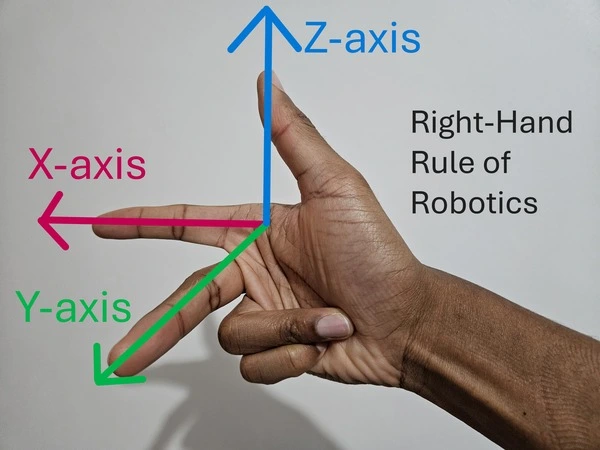
Knowing that different frames exist is only the first step. We need a rigorous mathematical way to convert coordinates from one frame to another. In robotics, this is handled by transformations, which include both rotations (orientation) and translations (position).
Rotation, Translation, and Homogeneous Transformation
- Rotation matrix RRR (3×3): describes the orientation of one frame relative to another. Because axes are orthonormal and perpendicular, RRR is orthonormal with determinant +1.
- Translation vector p (3×1): describes the displacement of the origin of one frame relative to another.
Rather than treat rotation and translation separately, robotics uses the Homogeneous Transformation Matrix (HTM), a 4×4 matrix that encodes both in a single object. With homogeneous coordinates (adding a 1 at the end of the usual [x, y, z] coordinate), one can apply both rotation and translation via matrix multiplication.
Formally, if you have a frame BBB relative to frame AAA, you denote the transformation matrix as TBAT^A_BTBA. Then, for a point PPP with coordinates PBP^BPB (in B-frame), its coordinates in A-frame PAP^APA are given by:
PA=TBA⋅PBP^A = T^A_B \cdot P^BPA=TBA⋅PB
This compact representation greatly simplifies the chaining of transformations.
Frame Composition (Chaining) and Inverse Transform
- Composition (Chaining): If you know the transformation from frame C to B (TCBT^B_CTCB) and from B to A (TBAT^A_BTBA), then you can find the transformation from C to A by multiplication:
TCA=TBA×TCBT^A_C = T^A_B \times T^B_CTCA=TBA×TCB
This ability to chain frame relationships is the basis of kinematics, localization, and sensor fusion.
- Inverse Transformation: When you need to go the other way (e.g., from A to B), you simply invert the homogeneous transformation. For rigid transformations, the inverse is efficiently computed by transposing the rotation block and adjusting the translation accordingly (rotation becomes R⊤, translation becomes −R⊤p).
In robotics applications (like computing where the end-effector is, or where a sensed object lies in world space), these operations are used extensively.
You can also find the In-person robotics workshop near you.
Agen234
Agen234
Agen234
Berita Terkini
Artikel Terbaru
Berita Terbaru
Penerbangan
Berita Politik
Berita Politik
Software
Software Download
Download Aplikasi
Berita Terkini
News
Jasa PBN
Jasa Artikel
News
Breaking News
Berita